Building a Forex EA Portfolio:
Why EUR/USD Is the Cornerstone
of Every Serious Automated Strategy
How to combine multiple Expert Advisors with different logic, pairs, and timeframes — with a rules-based, Myfxbook-verified EUR/USD EA as the disciplined anchor of your portfolio.
Every professional algorithmic trader eventually arrives at the same conclusion: a single EA, however well-built, cannot perform consistently across all market conditions. The solution isn't to keep searching for a perfect strategy — it's to build a coordinated portfolio of EAs. And at the heart of every robust automated portfolio sits one pair above all others: EUR/USD.
In this guide, we'll show you how to architect a diversified EA portfolio that reduces drawdown, smooths your equity curve, and keeps producing results even when individual strategies hit their inevitable rough patches. More importantly, we'll show you why a rules-based, pair-specialised EUR/USD EA isn't just one component of that portfolio — it's the disciplined foundation everything else is built on.
- Why a Single EA Will Always Let You Down
- Why EUR/USD Is the Ideal Portfolio Anchor
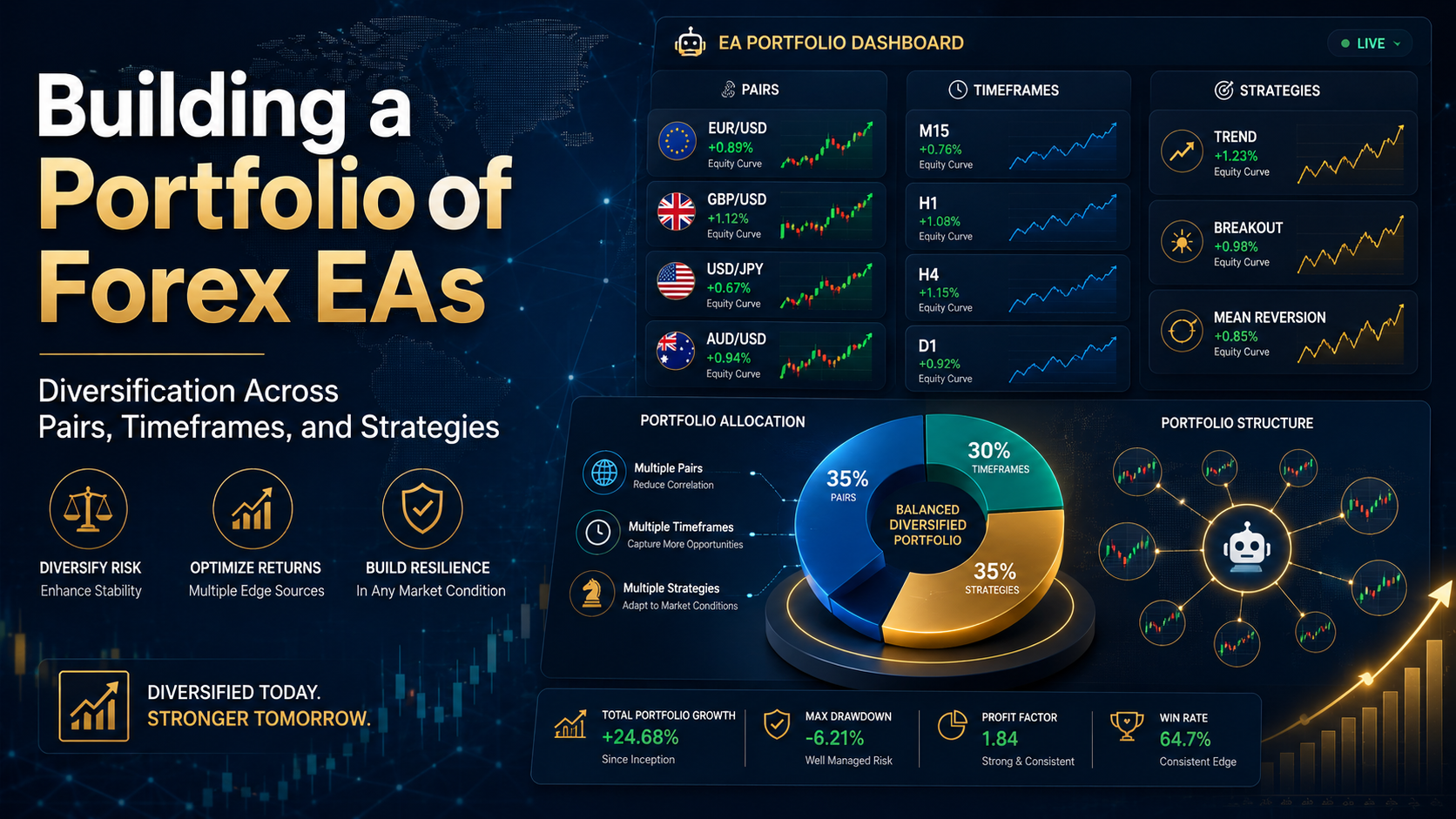
- The 3 Pillars of EA Portfolio Diversification
- Diversifying Across Currency Pairs
- Diversifying Across Timeframes
- Diversifying Across Strategies
- A Real-World Example Portfolio
- Risk Management Across Multiple EAs
- Common Mistakes to Avoid
- Tools & Resources
Why a Single EA Will Always Let You Down
Imagine you hired one employee to run your entire business. When they're energised, focused, and in their element — everything thrives. The moment they're sick, burnt out, or simply facing a challenge outside their skill set, your whole operation suffers. That's the reality of running a single Forex EA on a single account.
Every EA is coded around a specific belief about how markets behave. A trend-following EA profits when markets move directionally for extended periods. A mean-reversion EA profits when prices snap back to equilibrium. A scalping EA profits during short bursts of intraday momentum. None of these market conditions exist permanently — they rotate, often without warning.
"The goal isn't to find the perfect EA. The goal is to build a portfolio where the weakness of one strategy is always covered by the strength of another."
The consequences of single-EA dependency are predictable: extended drawdown periods that feel catastrophic, emotional decision-making at precisely the wrong moment, and accounts that look great for months before suffering a sudden, brutal correction. This is not a reflection of poor EA design — it's simply what happens when any single strategy encounters the market conditions it was not built for.
The professionals don't experience this because they don't rely on one strategy. They build portfolios. And that's exactly what we're going to help you do.
Why EUR/USD Is the Ideal Portfolio Anchor
Before exploring how to build a diversified EA portfolio, it's worth understanding why EUR/USD is consistently the pair that professional algorithmic traders use as their core holding — and why a specialist, pair-optimised EUR/USD EA belongs at the centre of your strategy stack.
EUR/USD's advantages for automated trading go far beyond volume. Because it is the world's most heavily analysed, most heavily traded, and most transparently priced currency pair, it offers automated systems a cleaner signal environment with less random noise than exotic or even most minor pairs. This means rules-based EAs — systems that rely on consistent, repeatable price behaviour — perform more reliably on EUR/USD than on nearly any other instrument.
There's also a practical reason: execution quality. With ultra-tight spreads and deep order books, an EA trading EUR/USD loses far less to slippage and spread than EAs trading wider pairs. Over hundreds of trades per year, this difference in execution cost is the difference between a strategy being profitable or marginal.
A generic multi-pair EA optimised across 10 instruments will always be outperformed by a pair-specialised EA optimised exclusively for one instrument. EUR/USD has unique microstructure, session dynamics, and volatility patterns. An EA built specifically around these characteristics — not adapted from a template — captures meaningfully more edge. This is the core philosophy behind a dedicated EURUSD Expert Advisor.
The 3 Pillars of EA Portfolio Diversification
A well-constructed EA portfolio doesn't just mean running several EAs simultaneously. True portfolio diversification operates across three distinct dimensions — and all three must be addressed for the approach to work. Think of them as the three pillars holding up your automated trading operation:
Currency Pair Diversification
Spreading exposure across pairs driven by different macroeconomic forces so a single market shock doesn't devastate your whole account.
Timeframe Diversification
Running EAs across M15, H1, H4, and D1 so your portfolio captures opportunities at multiple momentum cycles simultaneously.
Strategy Diversification
Combining trend-following, mean-reversion, and breakout logic so all market conditions — trending, ranging, volatile — are represented.
When these three pillars work in concert, the result is a portfolio equity curve that is smoother, more consistent, and more resilient than any individual EA's equity curve could be. Gains from well-performing strategies offset the temporary slumps of others, creating the kind of steady, forward-moving account growth that professional traders aim for.
Pillar 1 — Diversifying Across Currency Pairs
Understanding Correlation — The Hidden Risk Most Traders Miss
Correlation is the statistical measure of how closely two currency pairs move together, ranging from +1.0 (perfectly in sync) to -1.0 (perfectly opposite). This number is the single most important factor in determining whether your multi-pair portfolio is genuinely diversified — or just an illusion of it.
Running an EA on EUR/USD, GBP/USD, and AUD/USD simultaneously might feel diversified — but all three share the US Dollar as a base currency. A single Federal Reserve rate decision, NFP release, or Dollar-shock event can move all three against you at precisely the same moment, stacking losses across your entire portfolio. This is correlation risk — and it eliminates the entire point of having multiple EAs.
Real pair diversification means building exposure around pairs that respond to genuinely different macroeconomic drivers. Here's how to think about the structure of a well-diversified pair selection, with EUR/USD as the core holding:
| Pair | Key Driver | Session | Characteristic | Portfolio Role |
|---|---|---|---|---|
| EUR/USD ⭐ | ECB vs Fed policy | London / NY | Trending, high signal quality | Portfolio Core |
| USD/JPY | Risk sentiment / BoJ | Tokyo / NY | Safe-haven flows, divergent from EUR | Hedge / Balance |
| EUR/JPY | Risk appetite / flows | Tokyo / London | Momentum-driven cross | Cross Exposure |
| AUD/CAD | Commodities / China data | Sydney / NY | Range-bound, mean-reverting | Mean Reversion |
| GBP/JPY | BoE / risk flows | London open | High volatility, breakout | Volatility Play |
Notice that EUR/USD sits at the top as the core holding — not because it's simply the most popular pair, but because its signal quality, spread efficiency, and macro transparency make it the most reliable platform for a rules-based, systematic EA. The supporting pairs are chosen specifically because their dominant drivers (BoJ policy, commodity prices, risk sentiment flows) are largely independent from ECB/Fed dynamics.
An excellent tool for checking live pair correlations before assembling your portfolio is the Myfxbook Forex Correlation Tool. It provides real-time and historical correlation data across all major, minor, and cross pairs — essential reading before going live with a multi-pair strategy.
One critical nuance: measure the correlation between your EAs' equity curves, not just between the pairs themselves. Two EAs on different pairs but using identical logic (both trend-following, both triggered by the same conditions) can still produce highly correlated drawdowns. What matters is how their actual returns move relative to each other — not what currency is on the chart.
Pillar 2 — Diversifying Across Timeframes
EUR/USD on a 5-minute chart and EUR/USD on a 4-hour chart are, in practical terms, two entirely different trading environments. A scalping EA firing on M5 is responding to intraday microstructure — liquidity pockets, session opens, brief momentum bursts. A trend EA on H4 is responding to multi-day directional flows driven by macro sentiment. They can both be running on the same pair, in the same account, with minimal overlap in their trade logic.
- M5–M15 (Scalping): High trade frequency, small targets, profits accrue during peak volatility windows. Ideal during the London open (08:00 GMT) and NY overlap (13:00–15:00 GMT). Provides a steady income stream between larger trend positions.
- H1–H4 (Intraday to Short Swing): The backbone of most serious EA portfolios. Captures intraday momentum and multi-day directional moves. EUR/USD's trend characteristics make it particularly well-suited to H4 rules-based systems.
- H4–D1 (Swing / Position): Lower trade frequency but larger pip targets and stronger risk-reward ratios. Generates significant returns during macro-trend environments (rate cycle moves, risk-on/off periods). Provides the "big wins" that boost the portfolio's overall Sharpe ratio.
Running EAs across these timeframe bands means your portfolio is active across multiple momentum cycles simultaneously. While your H4 trend EA is patiently waiting for a high-conviction setup to mature over several days, your M15 scalper may have already executed 20 profitable trades. This temporal diversification — income arriving from different cycle lengths — is what creates the characteristic smooth upward slope of a well-constructed EA portfolio's equity curve.
Align your short-timeframe EAs specifically to peak-liquidity sessions: the London open and London/NY overlap produce the tightest spreads and strongest intraday moves on EUR/USD. Your longer-timeframe EAs can run around the clock since they're responding to multi-day momentum — session timing matters far less for H4 or D1 systems.
Pillar 3 — Diversifying Across Strategies
This is the most intellectually important dimension of EA portfolio construction. No single market condition persists forever. Trending environments give way to consolidation; high volatility periods are followed by compression. A portfolio that only contains one type of strategy logic will inevitably cycle through long periods of underperformance whenever its preferred market state is absent.
The Four Core EA Strategy Types and When They Shine
1. Rules-Based Trend-Following EAs — These are the backbone of a EUR/USD-focused portfolio. They use structured logic (moving averages, momentum indicators, price action signals) to identify and ride directional moves. EUR/USD's clean trending behaviour — driven by long central bank policy cycles — makes it an ideal pair for this strategy type. Critically, a truly rules-based trend EA applies the same logic in every market condition, removing emotion and discretion from execution.
2. Mean-Reversion EAs — Operating on the statistical principle that prices always return to their average, these EAs excel during range-bound and consolidating markets — exactly the conditions where trend-followers struggle. They most commonly operate on cross pairs (EUR/NZD, AUD/NZD, EUR/AUD) during the low-volatility Asian session, providing overnight portfolio activity when EUR/USD trend systems are largely inactive.
3. Scalping EAs — High-frequency, tight-target systems that capitalise on short bursts of intraday liquidity and momentum. Running a EUR/USD scalper during the London open and NY overlap generates a consistent trickle of profits that smooths the equity curve between larger trend trades. Because they operate on minute-level timeframes, their correlation with longer-timeframe systems is naturally very low.
4. Breakout EAs — These EAs target price expansion from defined consolidation zones or daily range extremes. They pair exceptionally well with mean-reversion systems: when a range holds, the mean-reversion EA profits from the bounce; when the range breaks, the breakout EA fires on the expansion. Together, they cover both outcomes of a consolidating market.
"A rules-based EUR/USD EA is not just another strategy in your portfolio. It's the disciplined core that your entire automated trading operation is built around."
A Real-World Example EA Portfolio
Let's translate theory into practice. Below is a concrete example of a well-diversified four-EA portfolio structured around a rules-based EUR/USD EA as the core holding. This is the architecture that professional algorithmic traders use to create all-weather, consistent automated trading systems:
| # | Role | Pair | Timeframe | Strategy | Session | Risk / Trade |
|---|---|---|---|---|---|---|
| 1 ⭐ | Portfolio Core | EUR/USD | H4 | Rules-Based Trend | London / NY | 1.0% |
| 2 | Intraday Engine | EUR/USD | M15 | Scalp / Momentum | London Open | 0.5% |
| 3 | Night Stabiliser | EUR/NZD | M30 | Mean Reversion | Asian Session | 0.5% |
| 4 | Cross Momentum | EUR/JPY | H1 | Breakout / Trend | London / Tokyo | 0.75% |
Why this structure works: EAs #1 and #2 both trade EUR/USD but on vastly different timeframes, meaning their trade logic and trigger conditions have minimal overlap — they are effectively operating in different market environments on the same instrument. EA #3 trades during Asian hours when EAs #1 and #2 are largely idle, providing 24/7 portfolio activity. EA #4 trades EUR/JPY — a pair that shares the Euro as a base but is driven heavily by Japanese risk-sentiment flows rather than ECB/Fed dynamics, providing genuine macro diversification.
Total maximum simultaneous risk: approximately 2.75% in the rare event all four EAs trigger at the same moment. In practice, session separation means this almost never happens. Compare this to a single-EA approach where a bad sequence of trades can draw down your account with nothing else contributing positive returns to offset it.
Risk Management Across Multiple EAs
Adding more EAs doesn't automatically reduce risk. Without proper portfolio-level risk controls, it can amplify risk significantly. Here are the five non-negotiable principles for managing a multi-EA portfolio safely:
Assign Every EA a Unique Magic Number
In MetaTrader 4, each EA must use a unique Magic Number to track and manage only its own trades. Without this, EAs can interfere with each other's open positions — closing the wrong trades, doubling positions unintentionally, or triggering conflicting exit logic. This is a foundational setup requirement, not optional.
Use Built-In Equity Protection on Your Core EA
The most robust EUR/USD EAs include a built-in equity protector — a hard stop that prevents the account from breaching a defined drawdown threshold (typically around 5%). This functions as an automatic circuit breaker, pausing the EA if conditions deteriorate beyond acceptable parameters. This is a critical safety net for any live account.
Set a Hard Portfolio-Level Drawdown Limit
Before going live, define the maximum portfolio drawdown at which you will pause ALL EAs simultaneously. Most professional algorithmic traders set this at 15–20% of total account equity. Consider using a dedicated portfolio monitoring EA or a VPS alert system to enforce this automatically rather than relying on manual monitoring.
Size Risk Proportionally to Confidence, Not Equally
Your highest-confidence, longest-live-track-record EA deserves the highest risk allocation — typically 0.75–1% per trade. New EAs being tested should start at 0.25–0.5% per trade regardless of how promising their backtest appears. Scale up allocation only as live performance is verified, ideally through independent tracking such as Myfxbook.
Use Conservative / Moderate / Aggressive Presets Strategically
If your core EA offers risk presets (Conservative, Moderate, Aggressive), use this as a dynamic tool — not a set-and-forget setting. During periods of elevated macro uncertainty (central bank meetings, CPI releases, geopolitical events), consider dropping all EAs to Conservative mode and returning to Moderate or Aggressive once volatility normalises.
Common Mistakes Traders Make Building EA Portfolios
An EA that has been fine-tuned to produce perfect results on historical data is not a reliable live trading system — it's a data-fitting exercise. Always validate EA performance on out-of-sample data (data the EA was never optimised against) and prioritise Myfxbook-verified live results over backtests when evaluating any EA for your portfolio.
Portfolio construction is not about quantity — it's about quality and genuine non-correlation. Running 10 or 15 EAs simultaneously creates an impossible monitoring burden, consumes excessive margin, and often produces very little additional diversification benefit beyond what 3–5 well-selected EAs would deliver. Start with a core EUR/USD EA and add supporting EAs one at a time, only after verifying each addition's impact on overall portfolio correlation.
A multi-EA portfolio generates significantly more trades than a single EA. Every additional trade incurs a spread cost. This is especially critical for scalping EAs: a difference of just 0.3 pips in average spread can be the margin between a profitable and a losing system over hundreds of trades. Always run live EAs on a broker with verified ECN execution and consistently tight EUR/USD spreads.
Backtests are a useful starting point for strategy evaluation — nothing more. They cannot account for slippage, variable spreads, broker requotes, or the shifting market dynamics that make live trading fundamentally different from historical simulation. Always insist on independently verified live performance data before allocating real capital to any EA.
Before adding any new EA to your live portfolio, run it in parallel on a funded demo account for a minimum of 60 days while your live portfolio continues operating. Only promote it to live trading once it demonstrates consistent performance in current market conditions and measurably improves your overall portfolio's risk-adjusted returns — not just its own standalone metrics.
Essential Tools & Resources for EA Portfolio Builders
Managing a multi-EA portfolio requires the right infrastructure. These are the platforms and tools that professional automated traders rely on:
The Bottom Line: Build a System, Not a Single Bet
The traders who build genuinely sustainable automated income are not those who locate the single greatest Forex EA in existence. They are the traders who think in portfolios — who understand that market regimes rotate, that no single strategy wins in every environment, and that the only way to create truly consistent returns across months and years is to build a coordinated system where every component has a defined role.
EUR/USD is the natural starting point for that system. Its unmatched liquidity, tightest spreads, highest signal quality, and clean trending behaviour — driven by two of the world's most transparent central bank policy cycles — make it the ideal anchor for any rules-based EA portfolio. Build your core around a pair-specialised, equity-protected EUR/USD EA with live Myfxbook verification. Then layer in complementary strategies across different pairs, timeframes, and logic types — each chosen deliberately to reduce correlation and cover the conditions your core EA doesn't target.
Do this systematically, validate each addition with real data, and manage risk at both the individual EA and portfolio level. That is what professional algorithmic trading looks like. And it starts with the right core.
Start With the Right Core: The Rules-Based EUR/USD Expert Advisor
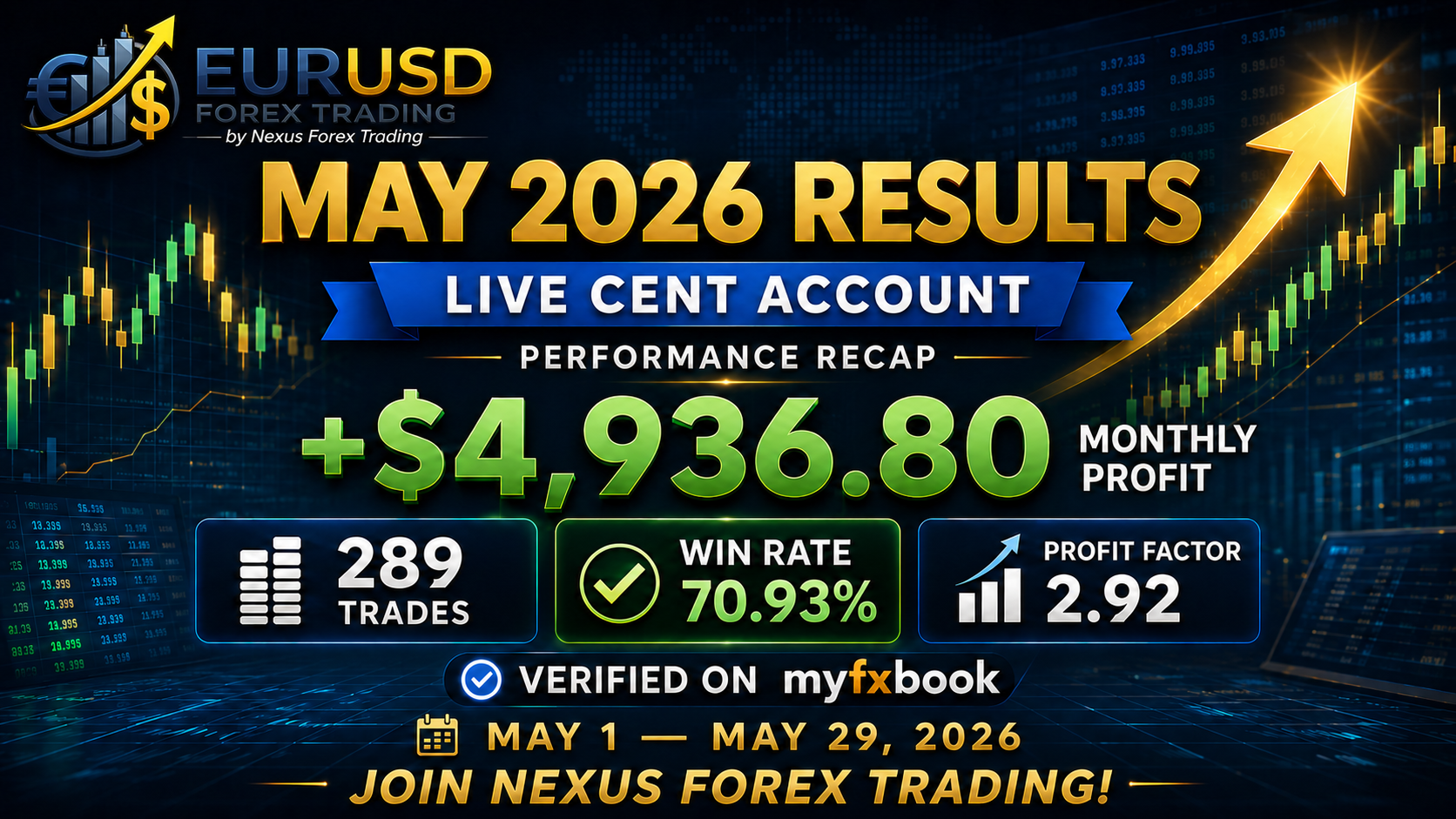
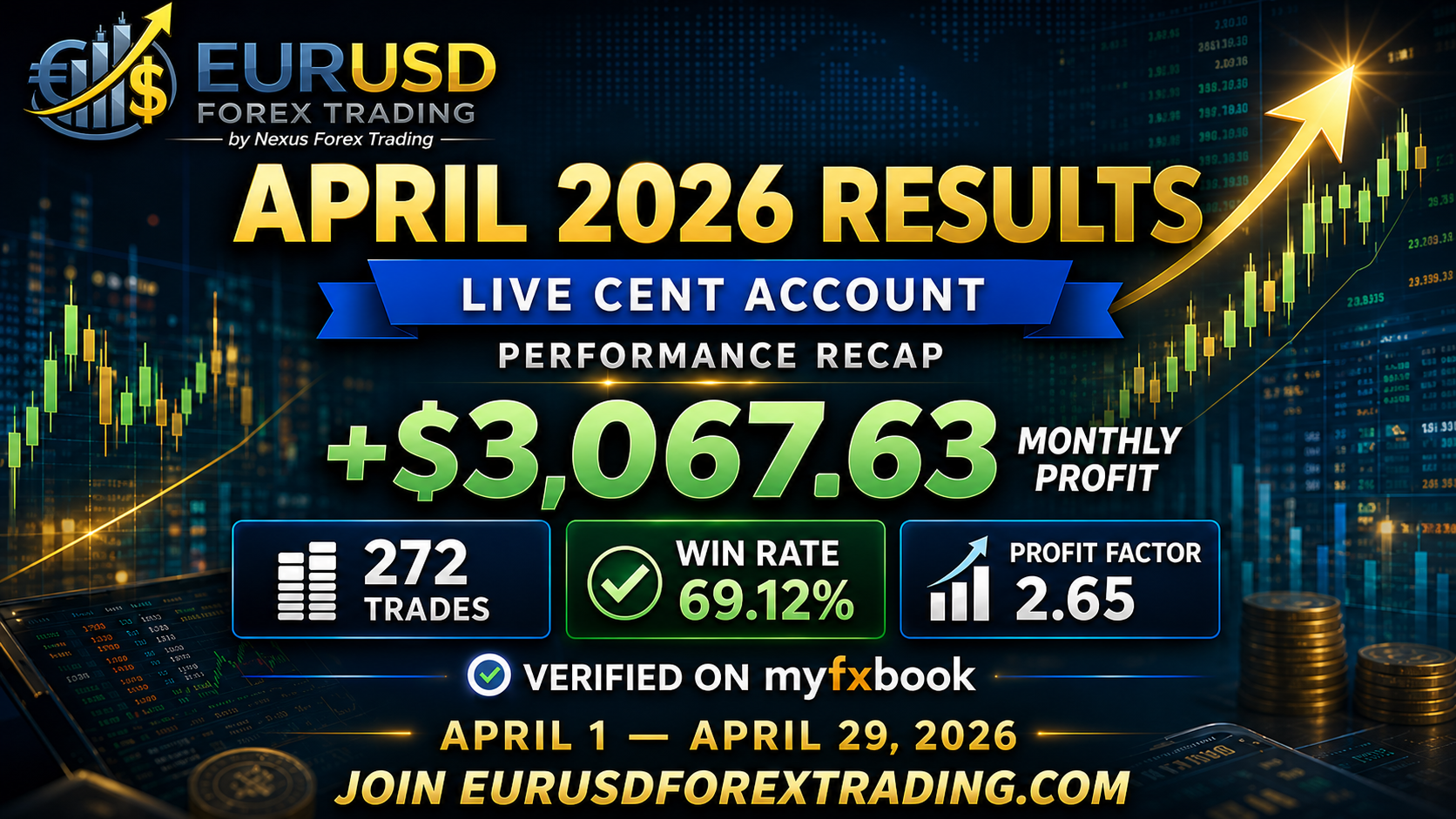
Don't build your EA portfolio on a foundation you can't verify. Our pair-specialised, rules-based EUR/USD EA comes with independently tracked Myfxbook live results, built-in equity protection, and Conservative / Moderate / Aggressive risk presets — ready to anchor your automated trading portfolio today.
📊 View Live Myfxbook Results First
Forex trading involves significant risk. Past performance is not indicative of future results. Trade responsibly.