Every forex trade is a currency pair trade. You are always buying one currency while simultaneously selling another. Understanding how pairs are structured — and why that structure matters — is one of the most underrated foundations in trading education.
This guide breaks down everything you need to know: how currency pairs work, the key differences between major, minor, exotic, commodity, and cross pairs, what drives their price, and how pair selection affects your trading costs, risk, and results.
What Is a Currency Pair?
A currency pair is simply a price relationship between two currencies. The first currency listed is the base currency. The second is the quote currency. The price tells you how much of the quote currency you need to buy one unit of the base.
Take EURUSD at 1.0850. That means 1 euro costs 1.0850 US dollars.
| Currency Pair | Base Currency | Quote Currency | What It Means |
| EURUSD | Euro | US dollar | Price of 1 EUR in USD |
| GBPUSD | British pound | US dollar | Price of 1 GBP in USD |
| USDJPY | US dollar | Japanese yen | Price of 1 USD in JPY |
| EURGBP | Euro | British pound | Price of 1 EUR in GBP |
When you buy a currency pair, you are buying the base currency and selling the quote currency. When you sell a currency pair, you are doing the opposite.
Example: Buying GBPUSD means you are buying British pounds and selling US dollars. If the price rises, your trade is profitable. If the price falls, it moves against you.
Why Pair Selection Is More Important Than Most Traders Realise
Not all forex pairs are created equal. The pair you choose affects nearly every dimension of your trading:
- Trading costs — spreads vary enormously between major and exotic pairs
- Slippage — thinner liquidity means larger gaps between your intended and actual fill price
- Volatility — some pairs move smoothly; others spike unpredictably
- Strategy compatibility — a system that performs well on EURUSD may fail completely on GBPJPY or USDTRY
- Execution quality — brokers often have tighter execution on more liquid pairs
This is especially critical for automated trading. Expert Advisors (EAs) depend on predictable spread conditions and consistent execution. A strategy tested on one pair cannot be assumed to work across all pairs without independent testing.
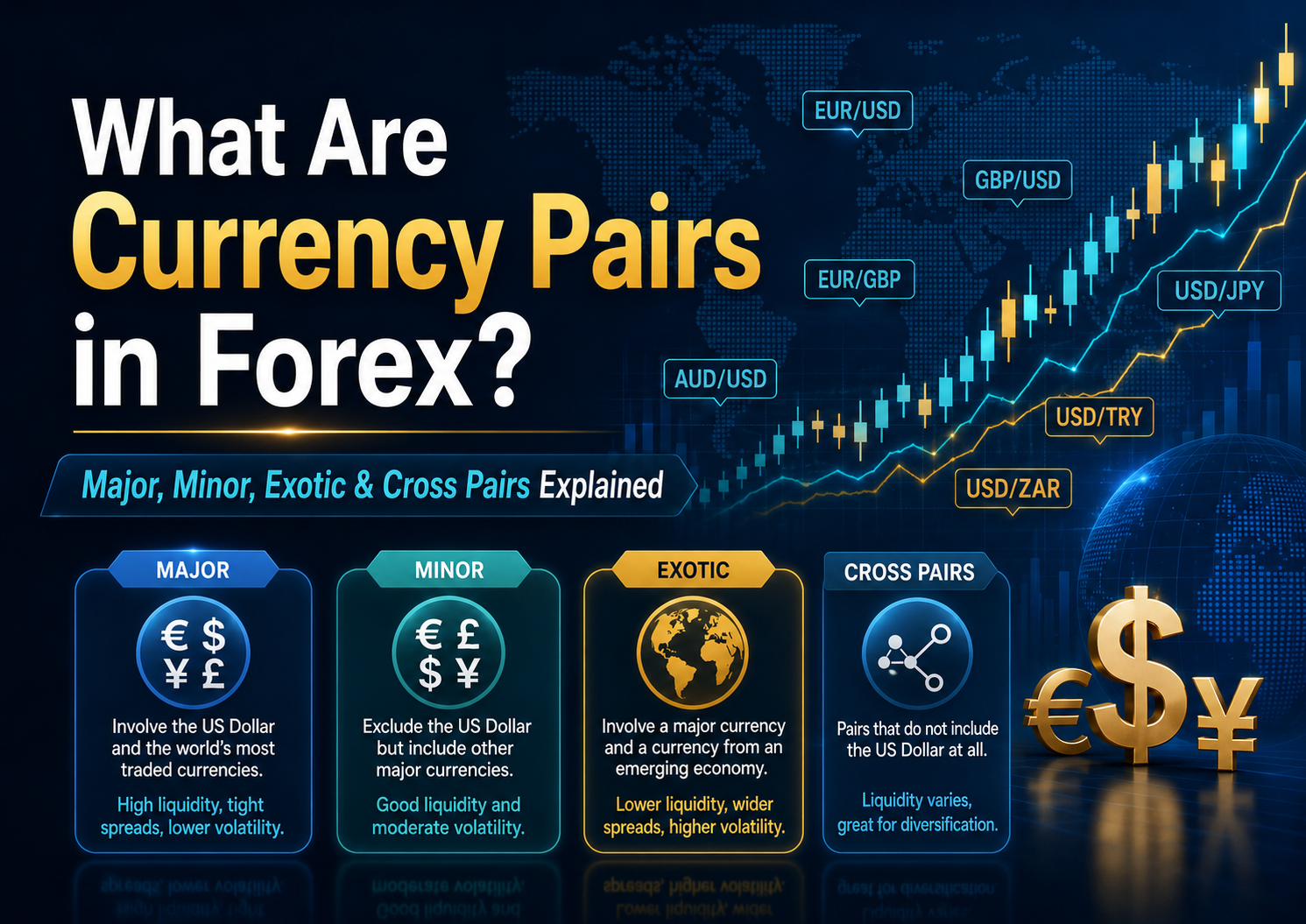
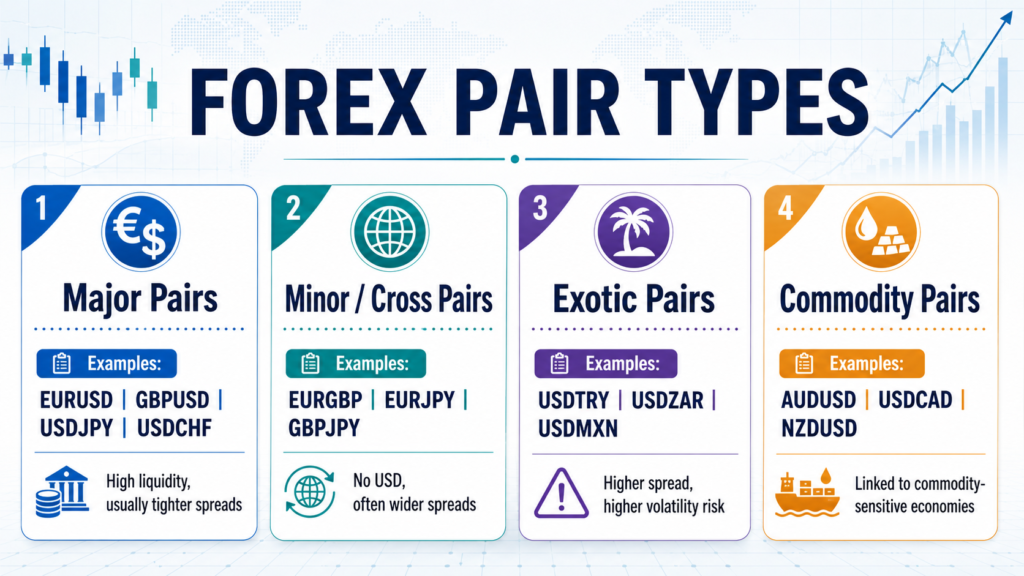
Major Currency Pairs
Major pairs are the most heavily traded in the world. They all include the US dollar paired with one other leading global currency. According to the BIS Triennial Central Bank Survey (April 2025), the US dollar appeared on at least one side of 89.2% of all global FX trades — which explains why USD-based pairs dominate forex activity.
| Pair | Currencies | Common Nickname |
| EURUSD | Euro / US dollar | Fiber |
| GBPUSD | British pound / US dollar | Cable |
| USDJPY | US dollar / Japanese yen | Ninja |
| USDCHF | US dollar / Swiss franc | Swissie |
| AUDUSD | Australian dollar / US dollar | Aussie |
| USDCAD | US dollar / Canadian dollar | Loonie |
| NZDUSD | New Zealand dollar / US dollar | Kiwi |
Major pairs generally offer tighter spreads, deeper liquidity, and more market commentary than any other category. For beginners, this makes them the most practical starting point.
EURUSD: The World’s Most Traded Currency Pair
EURUSD consistently accounts for the largest share of daily global forex volume. It represents the economic relationship between the eurozone and the United States — two of the most significant economic blocs in the world — which draws in banks, hedge funds, central banks, corporations, and retail traders alike.
Key drivers of EURUSD price movement:
- Federal Reserve interest rate decisions and forward guidance
- European Central Bank (ECB) monetary policy
- US CPI, PPI, and employment data
- Eurozone inflation and GDP figures
- US Treasury yields
- Broad USD strength or weakness cycles
- Global risk-on / risk-off sentiment
From a practical standpoint, EURUSD typically offers some of the tightest spreads available in forex. That matters more than most traders account for — especially in active or automated strategies where trading costs compound over hundreds of trades.
GBPUSD: High Opportunity, Higher Volatility
GBPUSD, nicknamed “Cable” (a reference to the transatlantic telegraph cable used to transmit exchange rates in the 19th century), is the second most popular major pair for many retail traders. It offers strong trending behaviour but is known for sharper, more aggressive intraday moves than EURUSD.
Key drivers of GBPUSD price movement:
- Bank of England (BoE) interest rate decisions
- UK inflation data (CPI, RPI)
- UK GDP, employment, and wage figures
- US dollar strength and Fed expectations
- UK fiscal and political developments
Because of its volatility, GBPUSD requires wider stop-loss placement and careful session management. London session hours tend to produce the most directional price action. Traders who work well with momentum strategies often find GBPUSD generates reliable setups — but the same characteristic that creates opportunity also accelerates losses when timing is poor.
Minor Currency Pairs (Cross Pairs)
Minor pairs, also called crosses, are pairs that include two major currencies but exclude the US dollar. They allow traders to express a view on the relative strength of two economies without taking a position on USD at all.
| Pair | Currencies | Theme |
| EURGBP | Euro / British pound | Eurozone vs. UK |
| EURJPY | Euro / Japanese yen | Eurozone vs. Japan |
| GBPJPY | British pound / Japanese yen | UK vs. Japan |
| EURAUD | Euro / Australian dollar | Eurozone vs. Australia |
| GBPAUD | British pound / Australian dollar | UK vs. Australia |
| CHFJPY | Swiss franc / Japanese yen | Safe-haven dynamics |
Spreads on minor pairs are typically wider than major pairs, and some — particularly GBPJPY — are known for large intraday ranges that demand wider stop losses and more careful position sizing. EURGBP, by contrast, often moves in a tighter range and can suit mean-reversion approaches.
Exotic Currency Pairs
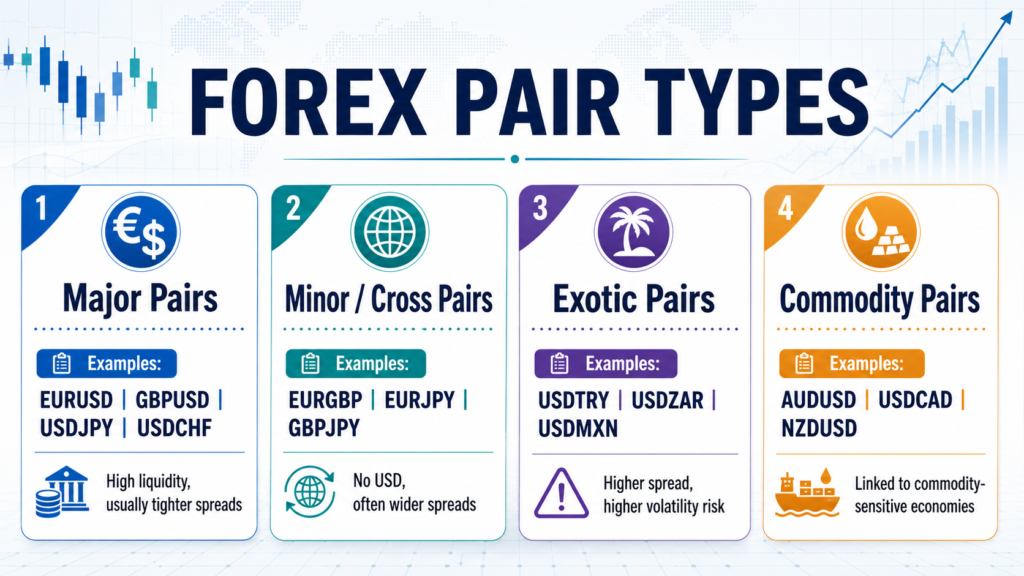
Exotic pairs combine a major currency with a currency from a smaller or emerging market economy. They can move significantly, but that volatility comes with meaningful drawbacks.
| Pair | Currencies |
| USDTRY | US dollar / Turkish lira |
| USDZAR | US dollar / South African rand |
| USDMXN | US dollar / Mexican peso |
| USDNOK | US dollar / Norwegian krone |
| USDSEK | US dollar / Swedish krona |
The real issue with exotics is not just volatility — it is tradability. Wide spreads mean a pair must move substantially just to break even on a trade. Liquidity gaps during off-hours can cause slippage that has nothing to do with strategy quality. News events — especially political or economic shocks in emerging markets — can produce price gaps that skip right through stop-loss levels.
For most retail traders and automated systems, exotic pairs require specific optimisation. Assuming a strategy built for EURUSD will work on USDTRY is a costly mistake.
Commodity Currency Pairs
Commodity currencies belong to economies whose export revenues are significantly tied to raw materials. Their exchange rates tend to correlate — imperfectly but meaningfully — with underlying commodity markets.
| Pair | Commodity Link |
| AUDUSD | Iron ore, coal, metals; sensitive to Chinese demand |
| USDCAD | Crude oil; Canada is a major energy exporter |
| NZDUSD | Agriculture, dairy exports |
For example, a sustained rally in oil prices often supports the Canadian dollar — though the relationship is not mechanical. Other factors, including BoC policy, US dollar trends, and global risk appetite, all play a role. Traders watching commodity pairs benefit from monitoring the relevant commodity markets as a contextual signal, not a trigger in isolation.
Cross Pairs Explained
Cross pairs are any pairs that exclude the US dollar. The terms “cross pair” and “minor pair” are often used interchangeably, though technically a cross pair can also include less liquid combinations not classified as standard minors.
The strategic value of cross pairs is directness. If you believe the euro will outperform the pound — for example, after a weak UK inflation print and a hawkish ECB — trading EURGBP is more direct than buying EURUSD and selling GBPUSD separately. You remove USD exposure and focus purely on the EUR/GBP dynamic.
| Cross Pair | What It Expresses |
| EURGBP | Eurozone strength vs. UK economy |
| EURJPY | Euro risk appetite vs. yen safe-haven |
| GBPJPY | GBP momentum vs. JPY positioning |
| AUDNZD | Trans-Tasman economic divergence |
| EURCHF | Eurozone risk vs. Swiss safe-haven demand |
How to Read a Currency Pair Quote
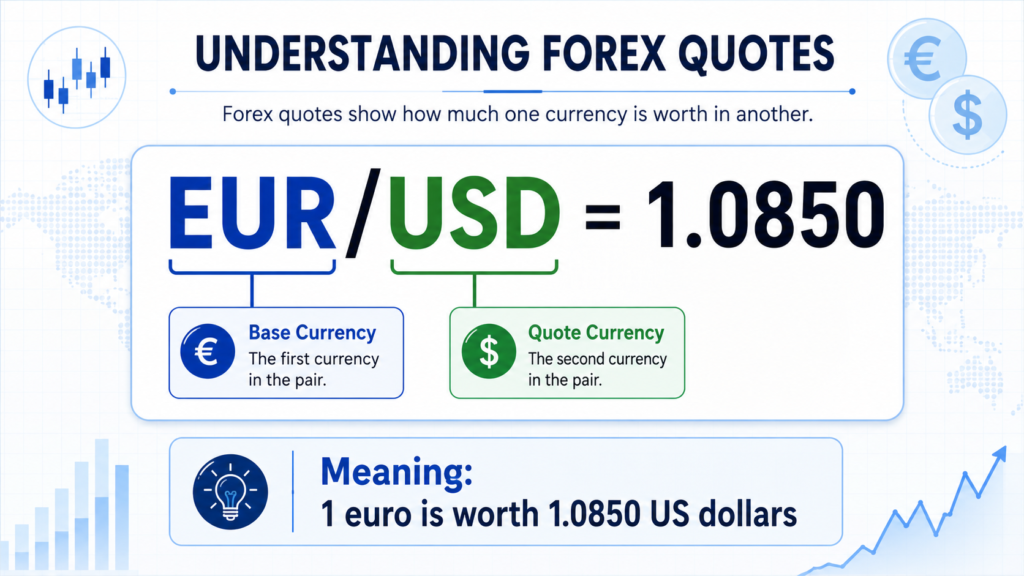
EURUSD = 1.0850 → 1 euro buys 1.0850 US dollars
If EURUSD moves from 1.0850 to 1.0950, the euro has strengthened against the dollar by 100 pips. If it falls to 1.0750, the euro has weakened by 100 pips.
GBPUSD = 1.2700 → 1 British pound buys 1.2700 US dollars
A rise in GBPUSD means the pound is gaining ground. A fall means the pound is losing ground relative to the dollar.
Example Trade: Buying EURUSD
| Trade Element | Example |
| Pair | EURUSD |
| Direction | Buy |
| Entry | 1.0850 |
| Stop loss | 1.0800 |
| Take profit | 1.0950 |
| Risk | 50 pips |
| Reward | 100 pips |
| Risk-to-reward ratio | 1:2 |
The setup anticipates euro strength from a technical support zone, with a 1:2 risk-to-reward structure. The most important discipline here is knowing your exit before your entry. A trader who knows exactly where they are wrong before taking a position is operating with a fundamentally different mindset than someone hoping the trade works out.
Example Trade: Selling GBPUSD
| Trade Element | Example |
| Pair | GBPUSD |
| Direction | Sell |
| Entry | 1.2700 |
| Stop loss | 1.2760 |
| Take profit | 1.2580 |
| Risk | 60 pips |
| Reward | 120 pips |
| Risk-to-reward ratio | 1:2 |
Here, weak UK economic data combined with persistent USD strength forms the basis for a bearish bias. A defined stop loss keeps the trade honest. Without pre-defined risk, a losing GBPUSD position can become emotional fast given how quickly the pair can move.
Spread, Liquidity, and Volatility: The Three Factors That Really Matter
Spread
The spread is the difference between the bid and ask price — effectively the minimum cost of each trade. Tighter spreads make a measurable difference for traders who enter and exit frequently. Over 200 trades per year, even a 0.5-pip spread difference per trade accumulates significantly.
Liquidity
Liquidity describes how easily a market absorbs orders without large price disruption. Highly liquid pairs like EURUSD handle large orders smoothly. Less liquid exotics can gap or slip on relatively small orders, especially outside major session hours.
Volatility
Volatility creates trading opportunity — but it must be appropriate for the strategy. A low-volatility pair may not generate enough movement to justify trading costs. An extremely volatile pair may trigger stops before the anticipated move develops. The goal is the right volatility profile for the specific approach being used.
The best currency pair is not the one that moves the most. It is the one that offers your strategy the optimal combination of movement, cost, liquidity, and execution reliability.
Why Focusing on EURUSD and GBPUSD Makes Strategic Sense
A common mistake among new traders is rotating through dozens of currency pairs looking for opportunity. This approach creates inconsistency — different spread profiles, different volatility rhythms, different news catalysts — and makes it nearly impossible to develop deep pattern recognition on any single market.
EURUSD and GBPUSD are strong candidates for focused trading because:
- They are two of the most liquid pairs in the world
- Spreads are consistently tight with quality brokers
- Both pairs have well-documented responses to macroeconomic data
- London and New York sessions — the most active trading windows — cover both pairs comprehensively
- Educational resources, market analysis, and historical data are widely available
For automated trading strategies in particular, the consistency of execution conditions on these pairs is a meaningful advantage. An EA running on EURUSD and GBPUSD operates in predictable spread environments; the same EA on USDTRY or GBPNOK faces conditions that are far harder to model reliably.
Checklist: Evaluating a Currency Pair Before You Trade It
Before committing capital to any forex pair, work through these questions:
- What category is this pair? Major, minor, exotic, cross, or commodity?
- What is the average spread? Does it suit your trading frequency and expected pip targets?
- What are the primary fundamental drivers? Which central banks, data releases, and macro themes move this pair?
- When is this pair most active? Which trading sessions generate the most volume and tightest conditions?
- What is the average daily range? Is there enough movement for your strategy to function, without excessive noise?
- How does this pair behave around high-impact news? Does it gap? Does it spike and reverse?
- Has your strategy been tested on this specific pair? Backtesting on one pair and live trading on another is a critical oversight.
Final Thoughts
Currency pairs are far more than ticker symbols. Each pair has its own volatility profile, liquidity characteristics, spread norms, news sensitivity, and intraday rhythm. EURUSD is not GBPJPY. USDCAD is not USDTRY. The rules that make one tradeable and profitable on a given approach may make another actively harmful to the same strategy.
Experienced traders tend to specialise. They study a small number of pairs deeply, develop an intuitive understanding of how those pairs behave across different market conditions, and build consistent processes around that knowledge. That specialisation compounds over time in a way that jumping between ten different pairs never does.
If you are early in your forex journey, EURUSD and GBPUSD offer a combination of educational resources, liquidity, and practical trading conditions that make them natural starting points. Master the pair before you try to master the market.
CTA: Join Nexus Forex Trading & Get an Extra 50% Discount
Ready to trade EURUSD and GBPUSD with a focused, rules-based MT4 Forex EA?
Join Nexus Forex Trading today and get access to automated EURUSD and GBPUSD trading tools built around structured execution, risk-first settings, and disciplined pair selection.
Use discount code:
nexus50fx
to get an extra 50% discount.
Join now: https://nexusforextrading.com/eurusd-gbpusd-ea-bot
Trade smarter. Focus on the right pairs. Let rules, not emotion, guide your forex decisions.